

The Shift
The Earth observation (EO) industry is entering a decisive new phase - one where success is no longer measured by the number of satellites launched, but by how seamlessly their insights integrate into decision-making. Although the market is valued at roughly $9 billion today, the sector is undergoing a fundamental identity shift: moving from capturing imagery to delivering continuous, decision-ready intelligence. Over the next three years, the most meaningful progress will not come from incremental improvements in sensor quality, but from technologies that make EO effectively invisible to the user - deeply embedded, automated, and delivering the right insight at precisely the right moment. PandionAI is positioned at the forefront of this transition.
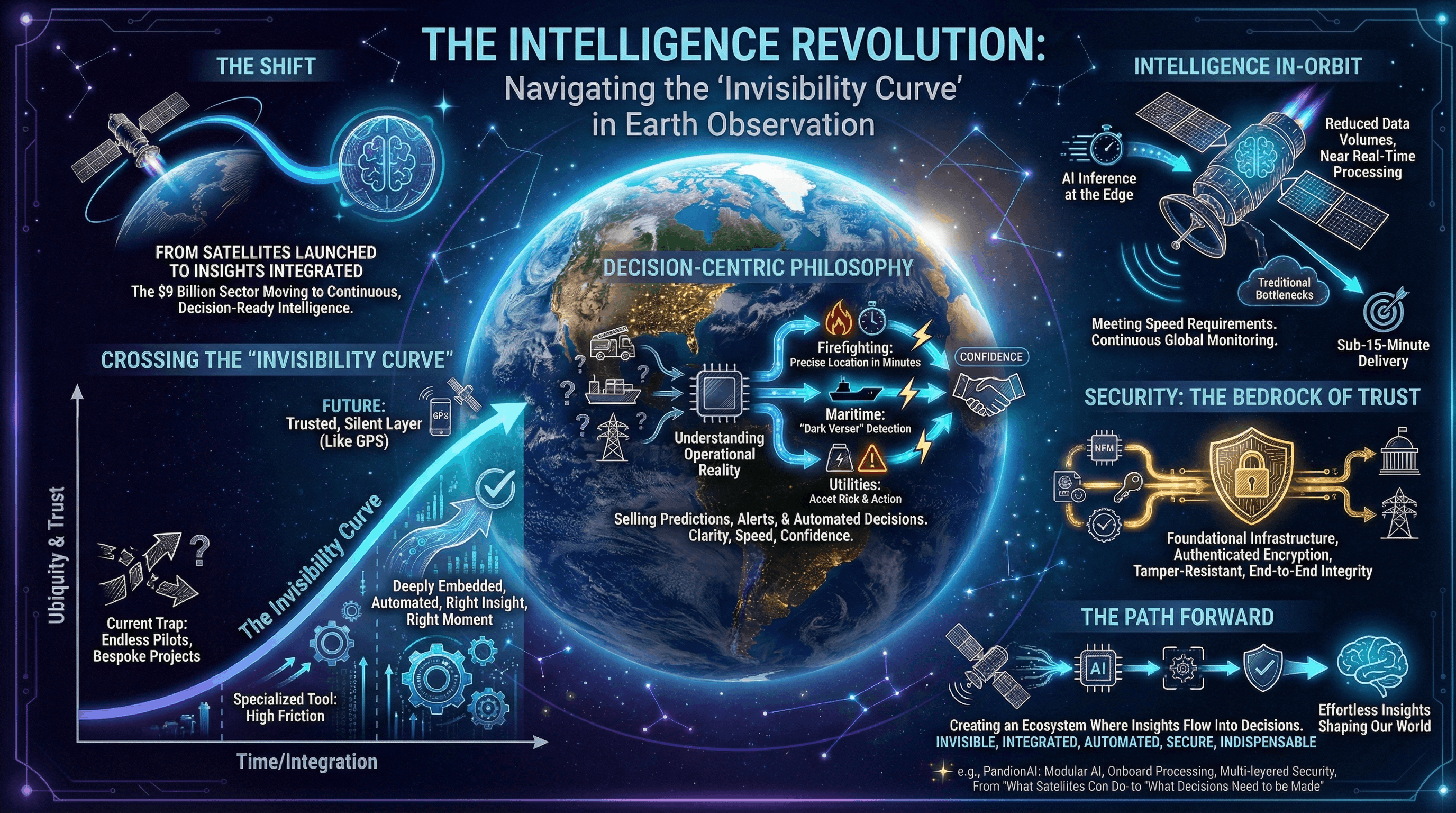 AI-generated illustration of PandionAI’s decision-centric Earth-observation narrative - largely correct, visually enthusiastic, and unapologetically confident
Crossing the “Invisibility Curve”
The most transformative technologies eventually fade into the background of everyday life. Global Navigation Satellite Systems (GNSS) are a prime example: billions rely on them daily, yet few ever consider the complex orbital infrastructure enabling their navigation apps. For EO to reach similar ubiquity and commercial scale, it must cross what Aravind Ravichandran describes as the Invisibility Curve - a point where EO becomes a trusted, silent layer of intelligence rather than a specialized tool.
Today, however, the EO industrial growth is constrained by two persistent structural traps:
- The Pilot Trap: Endless pilots and proof‑of‑concepts that never scale, often because outputs arrive as isolated dashboards or reports that fail to integrate into operational workflows.
- The Project Trap: Bespoke consultancy-style work that delivers value once, but cannot be repeated or scaled across customers or sectors.
Breaking free from these traps requires a shift in mindset - from “what satellites can do” to what validated information can be embedded into to customers workflows. The companies that succeed will be those that deliver automated, high-confidence answers rather than raw data, integrating directly into enterprise systems such as ERP platforms, asset management tools, or operational command systems.
A Decision‑Centric Philosophy
The next generation of EO must be defined by a deep understanding of the user’s operational reality. In mission-critical environments - disaster response, maritime security, infrastructure monitoring - decision-makers do not need more geospatial layers; they need clarity, speed, and confidence.
- A firefighting agency requires the precise location and movement of a fire front within minutes to deploy resources effectively.
- A maritime authority needs immediate detection of “dark vessels” operating without AIS to counter illegal fishing or smuggling.
- An energy utility must know which asset is at risk, why, and what action is required - not receive a folder of satellite images.
By internalizing these vertical workflows, EO providers can move from selling pixels to selling predictions, Alerts, and automated decisions. This evolution empowers users to act decisively without needing to be geospatial experts.
Intelligence In-Orbit
Meeting the speed requirements of modern decision-making demands a shift toward satellite-based Edge Computing. Traditional “bent‑pipe” architectures - where raw data is downlinked for ground-based processing - create bottlenecks, latency, and high operational costs.
By performing AI and machine learning inference directly in orbit, satellites can:
- Reduce data volumes by orders of magnitude
- Deliver actionable intelligence in near real time
- Prioritize only the most relevant events for downlink
- Enable continuous monitoring of specific areas or objects at global scale
This capability already enables sub‑15‑minute delivery of insights for time-sensitive operations. Combined with customer-based retraining of the AI models, this is a powerful tool for handling rapid critical events. Reinforcement Learning (RL) is also emerging as a key technology for autonomous constellation management, optimizing power, processing, and memory resources to maintain performance as fleets scale to hundreds of satellites.
Security: The Bedrock of Trust
As EO becomes a foundational digital layer for global society, the requirements for security, integrity, and trust increase dramatically. For dual‑use systems serving both civilian and defence requirements, cyber‑resilience is non-negotiable.
Modern EO architectures must integrate security across the entire chain:
- Security using Hardware Security Modules (HSMs) to protect customer data, information processes, and cryptographic keys
- Authenticated encryption to ensure every data transfer is pristine and verifiable
- Tamper-resistant communication to prevent spoofing, jamming, or man‑in‑the‑middle attacks
- End‑to‑end integrity checks ensuring that insights delivered to a user’s interface are authentic and unaltered
This level of protection is essential for building trust in automated, machine-generated intelligence - especially as EO becomes embedded in national infrastructure, information/production chains, and security operations.
Conclusion: Toward a Truly Intelligent EO Ecosystem
The Intelligence Revolution in Earth Observation is not about more satellites or higher resolutions. It is about creating an ecosystem where insights flow effortlessly into the decisions that shape our world. The winners will be those who make EO invisible - integrated, automated, secure, and indispensable.
PandionAI is building precisely this future: a world where satellite intelligence becomes a natural extension of human decision-making.
Strategic Market Response by PandionAI
As the EO industry accelerates toward an integrated, intelligence‑driven future, PandionAI stands out as a strategic enabler - bridging traditional space engineering with the demands of the NewSpace economy and the operational needs of end‑users. By combining a decision‑centric philosophy with advanced Edge AI, the company demonstrates how the next generation of EO capabilities is being translated into practical, scalable solutions to “Cross the Invisibility Curve”.
- Modular AI Information Chain
PandionAI has built a high‑efficiency Production Pipeline based on containerized, interoperable modules supported by Swedish National Space Agency (SNSA) and Sweden’s Innovation Agency (Vinnova). This architecture ensures scalability, resilience, and rapid deployment across diverse systems and missions.
- Optimized Acquisition: Collaborating with multiple satellite operators to minimize latency, increase revisit rates, and enhance system robustness.
- High‑Efficiency Processing: Deploying proprietary, qualitative AI models for precise object detection, classification, and event identification.
- Modular and flexible pipeline: In order to efficiently handle several different types of applications, the processor chain is built with modular building blocks that can be flexibly applied at different times in the processing.
- Enhanced Usability: Applying intelligent parameterization so that outputs integrate directly into customer workflows - whether through APIs, enterprise systems, or for support to the new end-user an intuitive graphical interface.
This modular chain transforms raw sensor data into validated, decision‑ready intelligence in a uniquely cost-effective way.
- Rapid Delivery
Funded by ESA Φ‑Lab Sweden, PandionAI’s Alert‑IOD project will together with its partners (Ubotica Technologies, Vinterstellar and Mimir Space Technologies) showcase the transformative potential of in‑orbit processing. The system will achieve a 99.9999% reduction in data volume while delivering mission‑critical intelligence in under 15 minutes. This capability demonstrates how Edge AI in-orbit can eliminate traditional bottlenecks and enable true real‑time responsiveness.
- Unassailable Security
Security is foundational to trust in automated intelligence. Through the SECURE project together with Clavister, PandionAI integrates multi‑layered cybersecurity across its processing pipeline:
- Hardware Security Modules (HSMs) for protecting cryptographic keys
- Digital signatures and authenticated encryption for end‑to‑end data integrity
- Tamper‑resistant communication protocols to prevent spoofing or interception
Every Alert delivered to a user is verifiable, authenticated, and protected.
- Dual‑Use Resilience
PandionAI supports both civilian and defence readiness through development programs designed to strengthen national resilience and operational autonomy:
- NJORD, in consultation with the Swedish Coastguard, enhances situational awareness for maritime and coastal security.
- EXODUS, in collaboration with OHB Sweden, has advanced PandionAI’s onboard AI technology - a key milestone toward operational security deployment.
- KONCEPT, pilots with energy and grid infrastructure companies such as EON, monitoring for disturbances and improved resilience over large areas.
These initiatives ensure that the company’s technology is robust, scalable, and suitable for high‑stakes environments.
PandionAI Delivering Clarity at Planetary Scale
By focusing on scalable services, automated intelligence, and deep integration into customer workflows, PandionAI is redefining what satellite systems can deliver. The company is not merely observing the planet - it is providing the real‑time clarity required to protect lives, strengthen resilience, streamline business processes, and support sustainable global growth.